A Nurse’s Critical Role: Recognizing and Supporting Child Trafficking Survivors

![[HERO] A Nurse's Critical Role: Recognizing and Supporting Child Trafficking Survivors](https://substackcdn.com/image/fetch/$s_!OSln!,f_auto,q_auto:good,fl_progressive:steep/https%3A%2F%2Fsubstack-post-media.s3.amazonaws.com%2Fpublic%2Fimages%2F9548821f-0729-4380-b6a1-039dab610b8c_1536x1024.png "[HERO] A Nurse's Critical Role: Recognizing and Supporting Child Trafficking Survivors")
Recent headlines have brought human trafficking into sharp focus for the American public. Yet for nurses working in emergency departments, pediatric clinics, school health offices, and community hospitals, trafficking isn’t breaking news: it’s a reality hiding in plain sight within our healthcare system. The difference is that many nurses don’t yet recognize it when it’s sitting right in front of them.
Child trafficking exists in every state, every socioeconomic bracket, and every community. Healthcare settings represent one of the few touchpoints where victims interact with professionals who could intervene. Research shows that 88% of sex trafficking victims accessed healthcare services while being trafficked, yet most left without being identified. This represents both a sobering failure and an extraordinary opportunity.
As nurses, we are uniquely positioned to recognize, respond to, and potentially rescue children caught in trafficking situations. But this responsibility requires specific knowledge, refined assessment skills, and trauma-informed protocols that most nursing programs never taught us. This article provides the comprehensive framework nurses need to fulfill this critical aspect of patient advocacy.
Understanding the Landscape: What Child Trafficking Actually Looks Like
Before we can identify victims, we must dismantle our misconceptions about what trafficking is and isn’t.
The Reality vs. The Stereotype
When most people think of human trafficking, they envision dramatic scenarios: children kidnapped by strangers, international smuggling operations, locked basement situations. While these cases exist, they represent a small fraction of trafficking realities.
The majority of child trafficking victims in the United States are:
Trafficked by someone they know: a family member, romantic partner, or trusted adult
Living at home or in unstable housing, not held captive in one location
Attending school sporadically or not at all
American citizens, not exclusively foreign nationals
Moved between locations regularly to avoid detection
Controlled through psychological manipulation, debt bondage, threats to loved ones, or substance dependency rather than physical restraints
Trafficking can involve sex trafficking, labor trafficking, or both. Sex trafficking of minors includes any commercial sexual exploitation of a person under 18: and critically, under federal law, no force, fraud, or coercion needs to be proven when the victim is a minor. The commercial sexual exploitation itself constitutes trafficking.
Labor trafficking involves force, fraud, or coercion to compel work or services. Children may be trafficked into domestic servitude, agricultural work, restaurant or factory labor, or forced criminal activity like shoplifting rings or drug distribution.
Who Is Most Vulnerable?
While any child can become a trafficking victim, certain populations face elevated risk:
Youth in foster care or group home settings (particularly those with multiple placements)
Runaway and homeless youth
LGBTQ+ youth, especially those rejected by families
Children with histories of sexual abuse
Youth with substance use disorders
Children with disabilities, particularly cognitive disabilities
Immigrant children, especially unaccompanied minors
Youth involved in the juvenile justice system
Children living in poverty or unstable housing
Native American and Alaska Native youth (disproportionately affected)
Understanding these risk factors helps us recognize when heightened vigilance is warranted, but we must never allow assumptions to blind us to victims who don’t fit expected profiles.
Red Flags: Clinical Indicators That Should Raise Concern

Trafficking victims rarely disclose their situations directly, especially during initial healthcare encounters. Our assessment must rely on recognizing patterns and inconsistencies that suggest something is wrong.
Physical Indicators
Look for:
Signs of physical abuse in various stages of healing (bruises, burns, cuts)
Branding or scarring that appears deliberate, particularly names or symbols
Untreated sexually transmitted infections, particularly multiple or recurrent STIs
Evidence of sexual trauma or assault
Frequent pregnancies or pregnancy terminations in adolescents
Signs of malnourishment or dehydration despite apparent access to resources
Poor dental hygiene or untreated dental problems
Evidence of substance use or withdrawal
Tattoos indicating ownership (money signs, barcodes, names, “Daddy”)
Exhaustion that seems disproportionate to stated activities
Behavioral and Psychological Indicators
Watch for patients who:
Demonstrate fear, anxiety, or hypervigilance
Avoid eye contact or appear coached on what to say
Show unusual deference to or fear of an accompanying adult
Provide scripted or inconsistent medical histories
Are unable to provide basic information about themselves or their location
Appear disoriented to time or place
Display symptoms of trauma including depression, PTSD, dissociation
Express hopelessness or lack of future orientation
Show evidence of self-harm
Demonstrate unusually sexualized behavior or knowledge for their developmental stage
Minimize abuse or injuries with rehearsed explanations
Situational Red Flags
Be alert when:
An adult refuses to allow the child to be interviewed alone
An adult answers all questions for the child or translates unnecessarily
The accompanying adult is not a parent or guardian and relationship is unclear
The patient has no identification, insurance, or personal possessions
The child doesn’t know their current address or living situation
There’s evidence of transience: multiple addresses in short time periods
The patient has no access to their own money or documents
An older “boyfriend” or “manager” accompanies a minor female patient
The patient lacks appropriate clothing for the weather or situation
Multiple people present share the same scripted story
The patient is brought in for care repeatedly at different facilities
Appointment patterns are erratic: long gaps followed by cluster visits
Payment is made in cash by someone other than a parent
Clinical Presentations That Warrant Screening
Certain chief complaints should automatically trigger trafficking assessment:
Repeated STI treatment, particularly in minors
Sexual assault examination
Pregnancy in young adolescents
Complications from unsafe abortion attempts
Substance use or overdose
Traumatic injuries with inconsistent explanations
Chronic pain without clear etiology
Mental health crisis, particularly suicidal ideation
Requesting Plan B or contraception without parental knowledge
Vague somatic complaints (headaches, stomach pain, fatigue)
The Trauma-Informed Assessment: How to Screen Effectively
Identifying potential trafficking victims requires different assessment skills than standard nursing practice. The goal is creating safety and opening a door, not forcing disclosure.
Creating the Right Environment
Before you can have meaningful conversation, you must establish conditions where disclosure becomes possible:
Separate the patient from companions. This is non-negotiable. Use standard protocols: “Our policy requires that we interview all patients privately for a few minutes.” Frame it as routine, not accusatory. If the companion refuses to leave, document this refusal thoroughly.
Build rapport first. Don’t lead with trafficking questions. Begin with normal intake procedures. Show genuine interest in the patient as a person. Simple kindness: offering water, a warm blanket, expressing concern for their comfort: can be powerful for someone accustomed to being treated as property.
Use trauma-informed language. Avoid judgment, shame, or language that implies the patient has done something wrong. Never use terms like “prostitute” or “illegal activity.” Recognize that trafficking victims often don’t identify as victims and may protect their exploiter.
Ensure interpreter services when needed. If a language barrier exists, use professional medical interpreters, never the accompanying adult. Traffickers often serve as “translators” to maintain control.
Screening Questions
The approach should feel like natural conversation, not interrogation. Consider these framing strategies:
General safety assessment:
“Do you feel safe where you’re living?”
“Is there anyone who makes you feel afraid or uncomfortable?”
“Has anyone ever hurt you or threatened to hurt you?”
Work and living situation:
“Can you tell me about where you’re staying right now?”
“Are you able to come and go as you please?”
“Do you have to do any work? What kind?”
“Are you able to keep the money you earn?”
“Do you owe anyone money?”
Relationship assessment:
“Who takes care of you?”
“Is there someone who tells you what you have to do?”
“Has anyone made you do things you didn’t want to do?”
“Has anyone taken your identification or important papers?”
For suspected sex trafficking:
“Has anyone ever asked you to do things for money or gifts?”
“Has anyone taken pictures or videos of you that made you uncomfortable?”
“Has anyone ever touched you in ways that didn’t feel right?”
Reading the Response
What the patient doesn’t say often matters as much as what they do say. Watch for:
Emotional response disproportionate to the question
Shutdown or dissociation when certain topics arise
Defensive protection of someone who appears to be harming them
Relief at being asked directly about their situation
Testing responses: giving small pieces of information to see how you react
Remember: Denial doesn’t mean nothing is wrong. Victims may deny for many reasons including fear of consequences, loyalty to trafficker, distrust of authorities, shame, or trauma bonding.
Documentation: Creating a Record That Protects
How we document suspected trafficking is critical for both patient safety and potential legal proceedings.
What to Document
Record objectively and thoroughly:
Exact quotes from the patient using quotation marks
Physical findings with body maps and photographs when permitted
Description of accompanying persons including physical appearance, behavior, and relationship to patient
Inconsistencies between patient statement and physical findings
Inconsistencies between different people’s accounts
Who answers questions and who remains silent
Patient’s affect, demeanor, and eye contact
Evidence of coaching or rehearsed responses
If patient was allowed to be interviewed alone or if this was refused
All people present during the encounter
What NOT to Document
Avoid:
Subjective language like “appears to be prostituting”
Assumptions about what the patient is experiencing
Detailed trafficking allegations in the medical record if this could endanger the patient (consult your institution’s protocol)
Immigration status unless clinically relevant
Information that could identify the patient’s location if they flee
Photography Protocol
When documenting injuries:
Obtain patient consent when possible
Photograph injuries with and without measurement scale
Include face in at least one photo for identification
Ensure medical record number is visible in photos
Follow your facility’s forensic photography protocols
Store images according to chain of custody requirements
Response Protocols: What to Do When You Suspect Trafficking

Suspecting trafficking is just the beginning. Your response must balance immediate safety, mandatory reporting, and patient autonomy.
Immediate Safety Assessment
First, determine acute risk:
Is the patient in immediate danger?
Is the suspected trafficker present in the facility?
Does the patient want to leave the situation?
Are there threats to the patient’s life?
Are other children at risk?
Mandatory Reporting Requirements
All 50 states mandate reporting of child abuse, and child trafficking constitutes abuse. However, reporting laws and procedures vary by state:
Know your state’s specific reporting requirements
Understand who is designated to make reports at your facility
Be aware of timelines: some states require immediate reporting
Document that a report was made, including to whom and when
Follow up to ensure the report was filed
Critical Consideration: In some cases, hasty reporting without safety planning can escalate danger. Consult with your social work team, risk management, or trafficking response specialists before acting, particularly when:
The patient is not in immediate physical danger
The patient is 17-18 (near majority but still a minor)
Reporting could result in deportation
There are concerns about CPS response capacity
This doesn’t mean don’t report: it means report strategically with expert consultation.
The National Human Trafficking Hotline
The National Human Trafficking Hotline (1-888-373-7888) is available 24/7 and offers:
Real-time consultation for healthcare providers
Connection to local trafficking-specific resources
Translation services in 200+ languages
Text option: Text “HELP” to 233733
Online chat at humantraffickinghotline.org
This resource is invaluable when you suspect trafficking but need guidance on next steps.
Patient-Centered Response
Even while fulfilling mandatory reporting, maintain focus on the patient:
Validate without forcing disclosure. “I’m concerned about your safety. If you’re ever in a situation where someone is hurting you or forcing you to do things you don’t want to do, there are people who can help.”
Provide information discreetly. Give resources in ways that won’t be discovered: memorized phone numbers, information written on medical discharge papers that seem routine, or details concealed in other materials.
Never promise what you can’t guarantee. Don’t promise confidentiality if you’re mandated to report. Don’t promise the patient won’t be separated from their trafficker if that’s not within your control. Don’t promise they won’t be detained by immigration. Honesty builds trust.
Respect autonomy where possible. For patients near majority or in situations where immediate danger isn’t clear, respect their agency. Forced “rescue” often traumatizes victims further and makes them less likely to seek help in the future.
Create opportunity for return. “If you change your mind or need help later, you can always come back here.” Provide follow-up appointments. Leave the door open.
Safety Planning
If the patient is willing to engage in safety planning:
Identify trusted adults in their life
Discuss safe places they could go
Establish code words for distress
Provide emergency contact information they can access
Discuss strategies for seeking help safely
Create a medical reason for return visits if needed
Building Institutional Capacity: Beyond Individual Response
Individual nurse vigilance matters, but institutional protocols amplify impact.
What Your Facility Should Have
Advocate for your institution to develop:
Written trafficking identification and response protocols
Mandatory trafficking training for all clinical staff
Private interview spaces in all clinical areas
Relationships with local trafficking service providers
Social work coverage trained in trafficking response
Clear reporting pathways that don’t rely on individual nurses knowing what to do
Multi-language resource cards
Specialized response teams for complex cases
Creating a Trafficking Response Team
Facilities serving high-risk populations should establish dedicated teams including:
Emergency department nurses and physicians
Pediatric specialists
OB/GYN staff
Social workers with trafficking expertise
Security personnel trained in de-escalation
Legal advocates
Mental health professionals
Community organization liaisons
Training Opportunities
Expand your expertise through:
National Human Trafficking Training and Technical Assistance Center resources
State-specific trafficking coalitions and task forces
SOAR to Health and Wellness training (free online program specifically for healthcare providers)
Polaris Project educational materials
Local law enforcement trafficking units (many offer training)
Trafficking survivor advocacy organizations
The Broader Context: Why This Matters for Every Nurse
Some nurses may think, “I work in a suburban pediatric practice. This isn’t relevant to me.” That assumption is dangerous.
Trafficking happens everywhere. The child who comes in for a sports physical, the teenager seeking Plan B, the patient with chronic unexplained pain: any of these encounters could be with a trafficking victim. Geography, socioeconomics, and practice setting don’t protect our patient populations from this crime.
Moreover, healthcare providers’ failure to identify trafficking has real consequences. Every missed opportunity means:
Continued exploitation and trauma
Escalating physical and psychological harm
Potential trafficking of additional victims
Lost evidence for prosecution
Reinforcement of victim’s belief that no one will help
Conversely, when we do intervene successfully, we change life trajectories. Survivors consistently report that one caring professional who took their situation seriously made the difference between continued exploitation and freedom.
Self-Care: Protecting Yourself While Protecting Others
Working with trafficking survivors takes a psychological toll. Recognize the signs of vicarious trauma and compassion fatigue:
Intrusive thoughts about patients’ experiences
Emotional numbness or difficulty feeling compassion
Hypervigilance in your own life
Difficulty trusting others
Sleep disturbances or nightmares
Sense of hopelessness
Questioning your effectiveness
Protective Strategies
Debrief after difficult cases with trained counselors or peers
Maintain clear professional boundaries
Engage in regular supervision
Practice self-compassion: you cannot save everyone
Balance this work with other clinical responsibilities
Utilize employee assistance programs
Connect with other healthcare providers doing this work
Remember: Offering help is success, even when patients aren’t ready to accept it
Your Professional Obligation

Human trafficking is not a niche issue or specialty concern. It’s a public health crisis intersecting with our daily practice. As nurses, we took an oath to protect the vulnerable, advocate for those without voice, and prevent harm.
Every shift, we have the opportunity to be the person who sees what others miss, who asks the question that opens the door, who provides the resource that changes everything. We also have the obligation to prepare ourselves for that moment before it arrives.
This means:
Educating ourselves beyond what this article provides
Advocating for institutional protocols and training
Maintaining awareness without becoming paranoid
Documenting thoroughly and objectively
Reporting appropriately according to legal and ethical obligations
Following up on our concerns rather than assuming someone else will handle it
Treating every patient with dignity regardless of circumstances
Recent events have brought trafficking into public consciousness in ways that are uncomfortable and disturbing. As healthcare providers, we must channel that awareness into concrete action. We must become the safety net that catches children before they fall further, the lifeline that pulls them back toward healing.
The knowledge in this article is just the beginning. The real work happens in exam rooms, emergency bays, and clinic hallways where you practice. It happens in the moment when something doesn’t feel quite right, and instead of dismissing that instinct, you lean into it. It happens when you choose to ask one more question, to offer one more resource, to document one more observation.
Your voice, your awareness, and your willingness to act may be the only thing standing between a child and continued exploitation. That’s not hyperbole: that’s the weight of our professional responsibility.
Resources for Continued Learning and Immediate Support
For Healthcare Providers:
National Human Trafficking Hotline: 1-888-373-7888
SOAR to Health and Wellness: Free online trafficking training for healthcare providers (soartohealthandwellness.org)
National Human Trafficking Training and Technical Assistance Center (nhttac.acf.hhs.gov)
Polaris Project Healthcare Provider Resources (polarisproject.org)
For Reporting and Intervention:
Childhelp National Child Abuse Hotline: 1-800-422-4453
National Center for Missing & Exploited Children: 1-800-843-5678
National Runaway Safeline: 1-800-786-2929
State-Specific Resources:
Contact your state’s Attorney General Office for local trafficking task forces
State Department of Health trafficking resources
Regional child advocacy centers
For Your Own Support:
SAMHSA National Helpline: 1-800-662-4357 (for substance use and mental health)
Employee Assistance Programs at your facility
Local counseling services specializing in healthcare provider trauma
The children sitting in our waiting rooms, lying on our exam tables, and passing through our emergency departments are counting on us: even when they can’t ask for help directly. We must be worthy of that trust. We must be prepared, informed, and willing to act.
Because somewhere today, a nurse will encounter a trafficking victim. Let it be a nurse who knows what to look for, what to ask, and what to do. Let it be you.
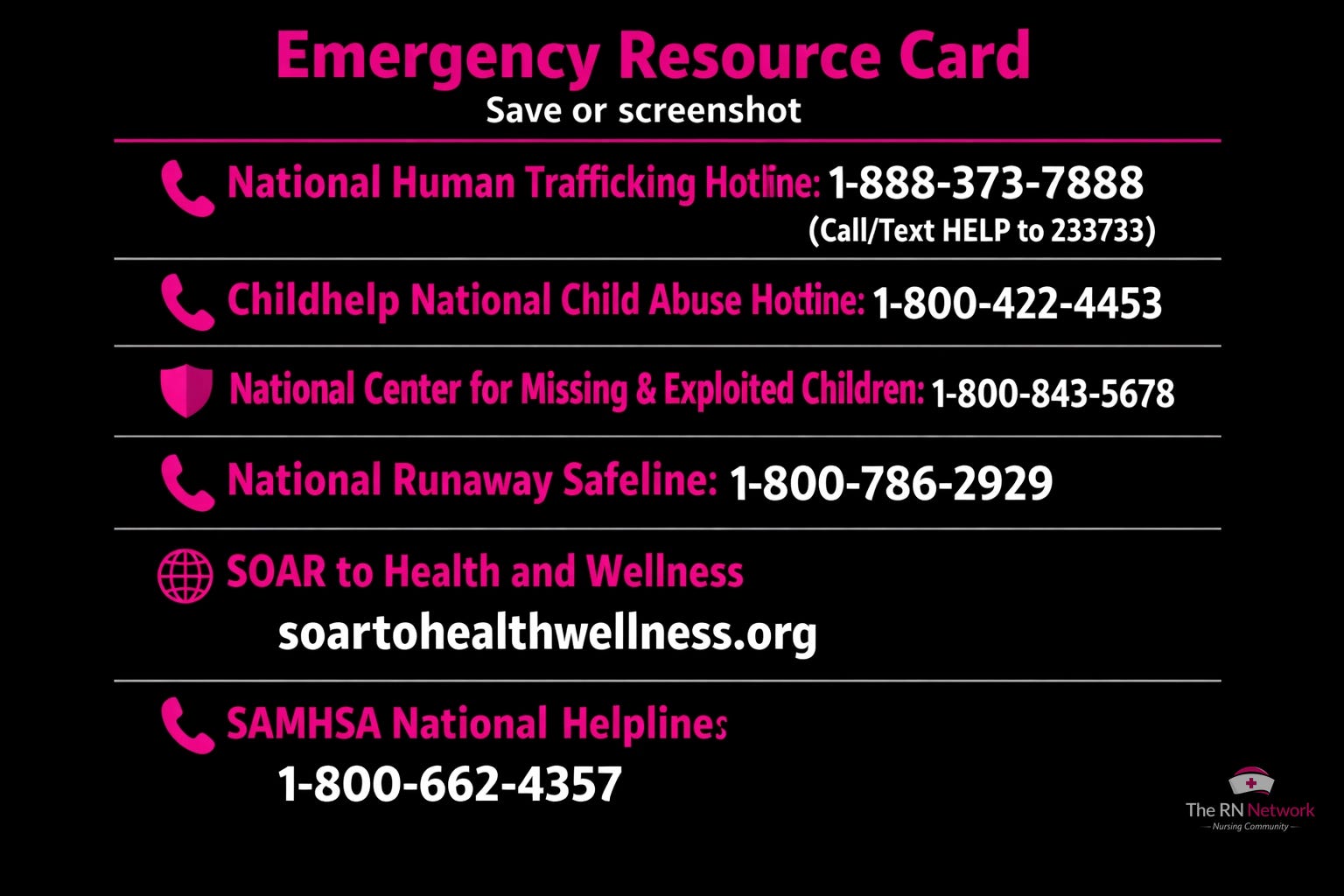
For more resources and professional networking opportunities for nurses, visit The RN Network. Please screenshot and save this emergency resource card in your phone.